Wire Types for Precision Coils - Round, Rectangular, and Foil

Key Technical Insights

  • Round wire with orthocyclic winding delivers the highest practical fill factor (>85 %) and the best magnetic reproducibility, since the self-guiding hexagonal packing fixes turn positions coil-to-coil.

  • Single, bifilar, trifilar, and quadfilar configurations are supported, and alpha winding enables both leads to exit from the same end of the coil.

  • Rectangular wire's theoretical packing advantage is offset in practice by edge rounding, larger insulation circumference, lack of self-guiding, and absence of orthocyclic voids for bonding material flow.

  • Drawing dies, controlled wire tension, and custom tooling can reduce diameter tolerance from ~10 µm to 0.1 µm, directly determining achievable magnetic field quality.


Open PDF Version

Introduction

Wire geometry determines fill factor, magnetic field quality, manufacturability, and cost. Selecting the right wire type is therefore an electromagnetic and manufacturing decision. In most applications, wire gauge can be selected late in the design process, since turns and current are tradeable for a given magneto-motive force requirement (see Functional Specifications for Precision Coils).

This paper covers round, rectangular, foil, and Litz wire. Conductor materials, insulation systems, and the choice between self-bonding and winding on core are treated in their respective companion papers.

Wire Type Comparison

Characteristic

Round (orthocyclic)

Rectangular

Foil

Litz

Theoretical fill factor

90.7%

~95%+

High (single axis)

50–70%

Practical fill factor

>85%

70–85%

Limited by inter-layer insulation

40–60%

Self-guiding

Yes

No

No

No

Magnetic reproducibility

Excellent

Moderate (operator-dependent)

Good

Moderate

Winding speed

High (CNC)

Low (operator attention)

Moderate

Low–moderate

Self-bonding compatibility

Excellent

Poor

Not applicable

Limited

AC loss performance

Moderate

Poor

Not applicable

Excellent

Typical applications

Beam shaping, actuators, sensors

High-current motors, edge-wound transformers

Power transformers, HF inductors

HF transformers, induction heating, RF

Round Wire

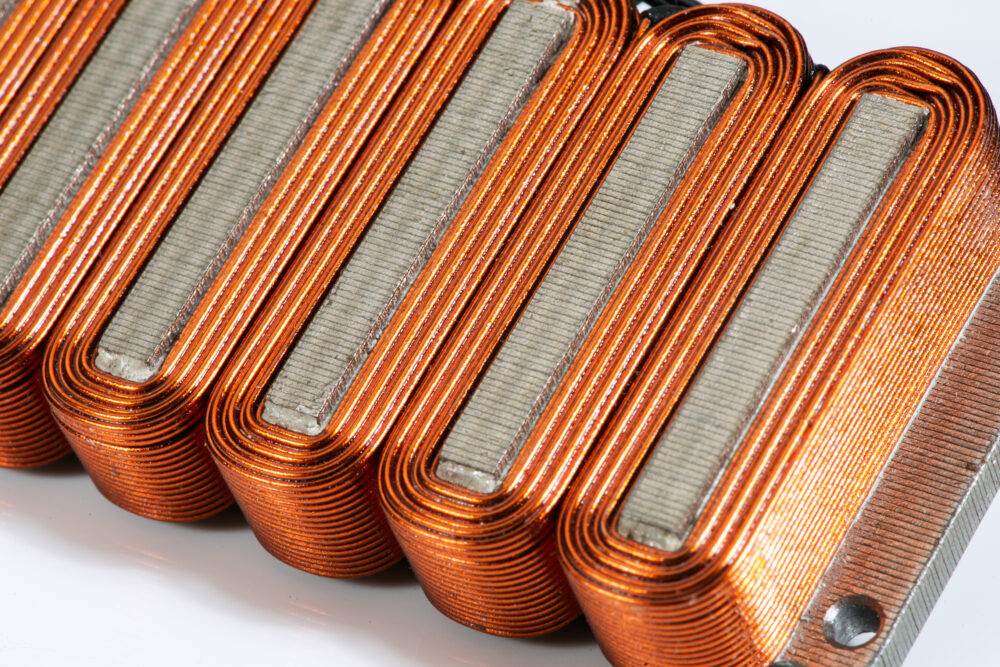
Round wire wound orthocyclically is the default for precision coil applications. Each turn nests into the groove formed by the two turns below it, producing a hexagonal close-packed cross-section that is self-guiding: once the first layer is positioned correctly, subsequent layers lock into place without operator intervention. This makes turn positions deterministic, and coil-to-coil conductor geometry is reproduced to within the cumulative tolerance of wire diameter and winding-space width — which translates directly to magnetic field reproducibility.

Beyond its functional advantages, an orthocyclic winding is also aesthetically the neatest winding pattern. The regular, tightly packed structure is immediately recognisable and serves as a visible indicator of process quality — an experienced engineer can assess winding quality at a glance.


A linear winding process is particularly advantageous due to its high winding speeds, minimal wire stresses ensuring low deformation, and the ability to program crossover positions [1]. Although a custom winding tool is required for high-speed winding, the low-wear tooling incurs minimal additional costs in series production.

Round wire is available in diameters from 40 µm to 3 mm. Standard supply holds diameter tolerance to approximately 10 µm. Where magnetic field quality demands tighter control, drawing dies reduce this to 0.1 µm by controlling die geometry and wear state, wire tension during drawing, and custom winding tooling matched to the precise wire diameter. At this tolerance level, die lubrication consistency and incoming inspection become essential (see Wire Sourcing and Incoming Inspection below).

Multi-strand configurations

Multi-strand configurations. Bifilar winding runs two wires simultaneously, producing matched resistance paths for differential sensing or balanced drive circuits. Trifilar and quadfilar configurations extend this to three and four conductors, enabling multi-phase windings, integrated sense coils, or redundant drive paths within a single winding operation. The orthocyclic self-guiding behaviour is preserved in all configurations provided the combined wire bundle nests correctly.

Rectangular Wire

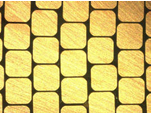
Rectangular wire offers a theoretical packing advantage: rectangular cross-sections tile a rectangular winding space with no voids. In practice, several factors erode this significantly.

Edge rounding

Edge rounding. The drawing or rolling process leaves rounded edges, introducing voids at every corner — precisely where the theoretical advantage was supposed to materialise.

Insulation penalty

Insulation penalty. For a given cross-sectional area, a rectangle has a larger circumference than a circle (~13 % more for a square, more for typical aspect ratios). Since insulation is applied uniformly around the circumference, rectangular wire carries proportionally more insulation per unit of copper.

No self-guiding

No self-guiding. Rectangular turns do not nest into self-locating grooves. Each turn must be guided into position, requiring constant operator attention and slower winding speeds. This increases cost and reduces magnetic reproducibility: turn positions vary coil-to-coil because they depend on operator skill rather than geometry.

Self-bonding limitations

Self-bonding limitations. Orthocyclic round wire creates triangular voids that provide flow channels for thermoplastic bonding material. Rectangular wire stacked face-to-face lacks these voids, resulting in weaker and less uniform bonds (see Self-Bonding vs. Winding on Core).

Despite these limitations, rectangular wire remains the right choice for very high-current single-layer edge-wound coils and motor windings with slot geometries that mandate rectangular conductors.

Foil Winding

Foil winding uses flat copper or aluminium strip, typically 0.05–2 mm thick, interleaved with insulation film. It serves high-current, low-voltage, low-inductance applications such as power transformers and high-frequency inductors. The large surface contact area provides excellent radial thermal conduction. Fill factor is high in the winding direction but limited axially by inter-layer insulation.

Foil winding is practical only for simple geometries, is not self-guiding, does not support post-winding bending, and is not compatible with self-bonding.

Litz Wire

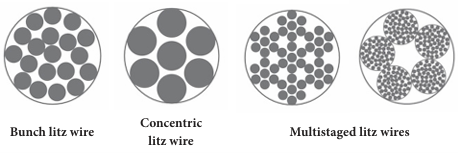
Litz wire consists of multiple individually insulated fine strands woven or braided together, mitigating skin effect and proximity effect losses at elevated frequencies. It is preferred for high-frequency transformers, induction heating coils, and RF applications where AC resistance dominates. The trade-off is fill factor: strand insulation and bundle packing limit practical fill factors to 40–60 %. Litz wire is also more expensive, harder to terminate, and not compatible with orthocyclic patterns. It is used only where AC loss reduction justifies these penalties.

Wire Sourcing and Incoming Inspection

Achieving 0.1 µm diameter tolerance requires a close relationship with the wire supplier. Drawing dies are subject to wear, and die replacement schedules must be agreed and verified. Lubrication consistency affects diameter uniformity and surface finish, which influence insulation adhesion and winding friction. Incoming inspection typically includes diameter measurement (statistical sampling across the spool), insulation thickness verification, and surface defect inspection. For self-bonding grades, bond strength testing of sample coupons is added. Inspection data is traceable to individual spools and linked to coil production records, closing the loop between wire quality and coil performance.

Q&A

Why can wire gauge be selected last in most coil designs?

The magneto-motive force required by the magnetic circuit is the product of turns and current. For a given MMF, the designer can trade more turns of finer wire (higher voltage, lower current) against fewer turns of heavier wire. Wire gauge falls out of the optimisation of voltage, resistance, and thermal dissipation, all of which can be finalised after wire type and coil geometry are decided.


How do drawing dies achieve 0.1 µm tolerance, and when is it worth the cost?

The wire is drawn through a precision die that controls the conductor diameter. At 0.1 µm tolerance, die wear, lubrication, and drawing speed all become critical — small changes shift the diameter outside specification. The cost is justified in precision magnets and beam-optics coils where diameter variation translates directly into parasitic field components. Note that is series production, with a stable supply chain and production tooling in place, the cost increase is minimal.

Why does rectangular wire typically yield a lower fill factor than round wire in practice?

Four factors combine: edge rounding introduces corner voids, larger circumference means more insulation volume, lack of self-guiding wastes space through misalignment, and for self-bonding applications there are no orthocyclic voids for adhesive flow. In production, these effects typically bring rectangular wire below well-executed orthocyclic round wire.

When is Litz wire the right choice despite its low fill factor?

When AC losses dominate — specifically, when skin and proximity effects at the operating frequency would make solid wire impractically lossy. As a rough guide, Litz wire becomes advantageous above approximately 10–50 kHz for typical wire sizes.

What is alpha winding and when is it needed?

Alpha winding starts from the centre of the wire, winding outward in both directions so that both leads exit from the same end. It is essential when lead routing is constrained, most commonly in galvo motors and certain actuators where connections must be accessible from one side only.

Discover our custom-designed coil assemblies

We partner with our customers to engineer and manufacture high-quality coils assemblies. Through close collaboration, we tailor each solution to meet exact application requirements—ensuring reliability, performance, and seamless integration into advanced systems.

More information


Contact our expert Stefan Slot

Get expert advice on custom coil assemblies tailored to your application.