Conductor Materials for Precision Coils

Key Technical Insights

  • Electrolytic copper (Cu-ETP) is the default conductor for precision coils, offering the best combination of conductivity, ductility, and supply chain maturity.
  • Material choice affects not just electrical performance but winding behaviour: aluminium requires lower tension, copper alloys with spring-back demand adapted tooling, and superconducting wire requires fundamentally different winding processes.
  • Oxygen-free copper is specified for vacuum and ultra-fine-wire applications where outgassing or ductility limits standard copper.
  • Each material requires matched winding parameters — tension, speed, nozzle geometry — and incoming inspection adapted to its specific failure modes.


Open PDF Version

Introduction

The conductor material sets the electrical, thermal, and mechanical baseline for a coil. While most precision coils use copper, the choice is not always automatic: weight constraints may favour aluminium, vacuum environments may require oxygen-free grades, self-carrying coils may need the spring-back of copper alloys, and superconducting magnets operate in an entirely different regime. This paper covers the principal conductor materials, their trade-offs, and how each interacts with the winding process.

Material

Conductivity (% IACS)

Density (g/cm³)

Key advantage

Typical use case

Copper (Cu-ETP)

100

8.96

Highest practical conductivity

Default for most precision coils

Oxygen-free copper (OFC/OFHC)

101

8.94

Reduced outgassing, improved ductility

Vacuum, ultra-fine wire

Aluminium

61

2.70

Low weight (~30 % of Cu)

Weight-critical, large transformers

Silver

106

10.49

Highest conductivity

Specialised RF and cryogenic

Copper-clad aluminium (CCA)

65–70

3.6 – 4.0

Weight/cost compromise

Cost-sensitive, weight-conscious designs

Copper alloys (CuBe, CuNiSi)

20–60

8.2 – 8.8

Spring-back, mechanical strength

Self-carrying coils, elastic recovery

NbTi

Superconducting below 9.2 K

6.0

High critical field, ductile

MRI, accelerator magnets

Nb₃Sn

Superconducting below 18.3 K

8.9

Higher critical field and temperature

High-field research magnets, fusion

Electrolytic Copper

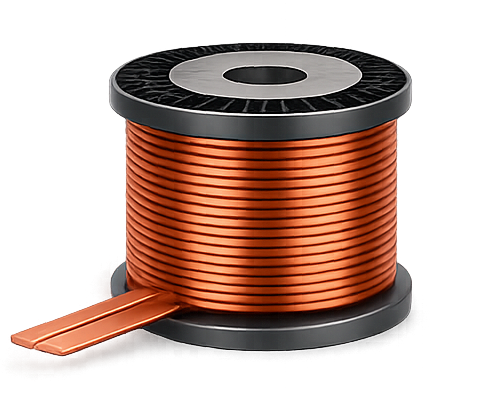
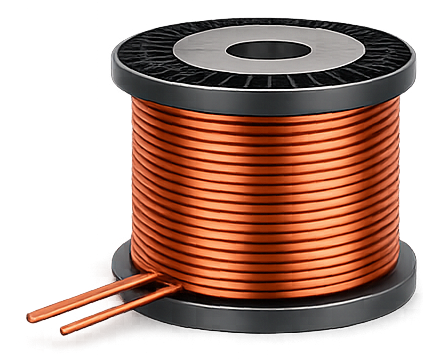
Cu-ETP (>99.9 % purity) is the standard against which all alternatives are measured. Its conductivity, ductility, solderability, and availability make it the default choice unless a specific application requirement forces a different material. The drawing and enamelling supply chain for Cu-ETP is mature, meaning wire is available in the full diameter range (40 µm to 3 mm) with all IEC 60317 insulation grades, including self-bonding variants.

Oxygen-Free Copper

Oxygen-free copper (OFC, also designated OFHC or Cu-OF) reduces the oxygen content to below 10 ppm, compared to up to 400 ppm for Cu-ETP. This eliminates outgassing, making it the standard choice for coils operating in vacuum systems and in hydrogen-atmosphere brazing (hydrogen embrittlement), e.g. beam-line magnets, electron-optics assemblies, and vacuum-chamber actuators. OFC also offers slightly improved ductility, which matters for ultra-fine wire below approximately 50 µm, where standard Cu-ETP can become brittle during drawing. The cost premium over Cu-ETP is moderate, and availability in precision wire diameters is good. Unless the application specifically requires vacuum compatibility or extreme ductility, the premium is not justified.

Aluminium

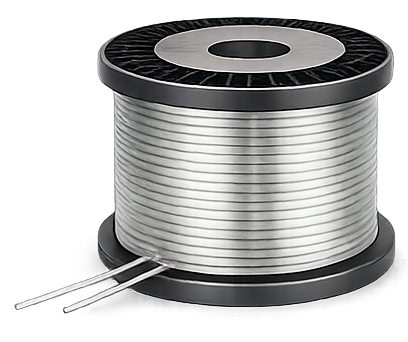
Aluminium provides approximately 61 % of copper's conductivity at 30 % of its density. For the same resistance, an aluminium conductor requires roughly 60 % more cross-sectional area but weighs only half as much as the equivalent copper conductor. This trade-off favours aluminium in weight-critical applications such as airborne instruments, satellite components, and large power transformers where total mass matters. Aluminium is softer than copper and more susceptible to nicking and surface damage during winding. Wire tension must be reduced, guiding must be gentler, and tooling surfaces must be polished to avoid marking the conductor. Insulation adhesion to aluminium can also be weaker than to copper, requiring adapted enamel formulations.

Copper Alloys

In self-carrying coils that must maintain their shape under mechanical load, copper alloys with controlled spring-back are sometimes used. CuBe2 (beryllium copper) and CuNiSi (copper-nickel-silicon) offer significantly higher yield strength and elastic recovery than pure copper, allowing the coil to survive handling, installation, and service loads without permanent deformation. The trade-off is conductivity: CuBe2 typically provides 20–25 % IACS, CuNiSi around 40–50 % IACS. This reduction is accepted when the mechanical requirements cannot be met by pure copper, even with self-bonding. The higher stiffness also means higher winding forces, which increases the risk of insulation damage and demands adapted tooling and tension profiles (see Wire Insulation for Precision Coils).

Other Materials
Silver

Silver (106 % IACS) offers the highest conductivity of any metal but at prohibitive cost for most applications. It is used in specialised RF coils where the skin-depth conductivity of the outermost layer matters, and in certain cryogenic applications where the residual resistance ratio of high-purity silver provides an advantage.

Copper

Copper-clad aluminium (CCA) uses a thin copper layer over an aluminium core, providing a compromise between the conductivity of copper (at the surface, where AC current flows) and the weight of aluminium. CCA is used in cost-sensitive and weight-conscious designs where neither pure copper nor pure aluminium is optimal.

Superconducting Wire

Niobium–titanium (NbTi) and niobium–tin (Nb₃Sn) are the principal superconducting wire materials for high-field magnet applications. NbTi is a ductile alloy with a critical temperature of 9.2 K and an upper critical field of approximately 15 T at 4.2 K. Its ductility makes it relatively straightforward to draw into fine filaments and wind into coils using adapted versions of conventional winding processes. NbTi is the standard conductor for MRI magnets, particle accelerator dipoles and quadrupoles, and laboratory solenoids operating below approximately 8–9 T.
Nb₃Sn is an intermetallic compound with a higher critical temperature (18.3 K) and upper critical field (approximately 25–30 T at 4.2 K), enabling magnets that operate well beyond the NbTi limit. However, Nb₃Sn is brittle in its reacted state, which fundamentally changes the manufacturing sequence: the coil must be wound from unreacted precursor wire and then heat-treated at approximately 650 °C to form the superconducting phase. This wind-and-react process requires tooling and insulation that survive the reaction heat treatment, and the finished coil cannot be reworked. Nb₃Sn is used in high-field research magnets, fusion reactor coils, and next-generation accelerator magnets.
Both materials are supplied as multifilamentary composites — fine superconducting filaments embedded in a copper or copper-alloy matrix that provides thermal stabilisation and current sharing during transient events. The winding process differs from conventional enamelled wire, although not fundamentally: insulation systems, tension control, and bend radii must all be adapted to the specific wire architecture.

Winding Process Adaptation by Material

Each conductor material requires matched winding parameters. The table below summarises the key adaptations.

Parameter

Cu-ETP

OFC

Aluminium

Copper alloys

NbTi / Nb₃Sn

Tension

Standard

Standard

Reduced (soft)

Increased (stiff)

Carefully controlled

Speed

High

High

Moderate

Moderate

Low

Tooling surface

Standard

Standard

Polished (nicking risk)

Hardened (high forces)

Application-specific

Insulation risk

Standard

Standard

Adhesion, nicking

Damage from high forces

Reaction-compatible

Key concern

—

Outgassing control

Surface damage

Spring-back management

Bend radius, brittleness

The essential point is that winding process parameters — tension, speed, nozzle geometry — must be matched to the conductor material, not just the wire diameter. A process validated for Cu-ETP cannot be transferred to aluminium or CuBe2 without re-qualification.

Incoming Inspection and Traceability

Incoming inspection requirements vary by material. Cu-ETP and OFC are inspected for diameter, insulation thickness, and surface defects. Aluminium adds adhesion testing of the insulation. Copper alloys require hardness and spring-back verification to ensure the mechanical properties match the coil design assumptions. Superconducting wire is characterised for critical current (Ic) at the operating field and temperature. For all materials, inspection data is traceable to individual spools and linked to coil production records. This traceability is essential for root-cause analysis when coil performance deviates from specification.

Q&A

Why is Cu-ETP the default rather than oxygen-free copper?

OFC eliminates oxygen-related issues (outgassing, hydrogen embrittlement) but costs more and offers only marginal conductivity improvement. For coils that do not operate in vacuum or require ultra-fine wire, Cu-ETP's mature supply chain and full insulation-grade availability make it the more practical choice.

How does aluminium's softness affect winding quality?

Aluminium nicks and deforms more easily than copper during winding. Without reduced tension and polished tooling surfaces, the conductor can sustain surface damage that locally reduces cross-section and creates stress concentrations under the insulation. These defects may not be visible but can affect resistance uniformity and long-term reliability.

When do copper alloys justify their conductivity penalty?

When the coil must maintain its shape without external support — specifically, when self-bonding alone does not provide sufficient mechanical stiffness for the handling, installation, or service loads. This is most common in self-carrying coils that undergo significant vibration, shock, or thermal cycling. If the application can tolerate external fixation (bobbins, potting), pure copper with self-bonding is usually the better trade-off.

What makes Nb₃Sn winding fundamentally different from conventional coil winding?

Nb₃Sn is brittle after the heat treatment that forms the superconducting phase, so the coil must be wound from ductile precursor wire and then reacted at ~650 °C. This means the tooling, insulation, and coil structure must all survive the reaction temperature — ruling out conventional enamel insulation and most self-bonding approaches. The coil cannot be reworked after reaction, so first-pass winding quality is critical.

Does conductor material affect magnetic field quality?

Indirectly, yes. Material properties influence how precisely turns can be positioned: softer materials may deform under winding tension, changing the cross-section; stiffer materials may spring back, shifting turn positions. Both effects alter the conductor geometry from the design intent, introducing parasitic field components. The winding process must be adapted to the material to maintain the same field quality.

Discover our custom-designed coil assemblies

We partner with our customers to engineer and manufacture high-quality coils assemblies. Through close collaboration, we tailor each solution to meet exact application requirements—ensuring reliability, performance, and seamless integration into advanced systems.

More information


Contact our expert Stefan Slot

Get expert advice on custom coil assemblies tailored to your application.