Self-Bonding vs. Winding on Core

Key Technical Insights

  • Self-bonding is the preferred construction for most precision coil applications, offering superior reworkability, mechanical stability, thermal performance, and lifetime — at lower cost.

  • Self-bonding coils absorb minor winding damage in the bonding layer, are inherently resistant to vibration, shock, and thermal cycling, and eliminate the micro-gaps that cause partial discharge in core-wound coils over time.

  • Winding on core retains an advantage only in very high-temperature applications where the self-bonding material would reflow, or where the core provides a structural function that cannot be replaced.

  • Electrical baking for self-bonding takes seconds, while core-wound coils typically require adhesives, tie-downs, or potting — adding cost, complexity, and tolerance chain links.


Open PDF Version

Introduction

One of the earliest decisions in coil design is whether the winding will be self-supporting (self-bonding) or wound onto a bobbin or core. This choice shapes the entire manufacturing process, the tolerance chain, and the coil's long-term performance. Both approaches are well established, and both are used in production — but they are not equivalent, and in most precision applications, self-bonding is the stronger choice. This paper explains why, and identifies the narrower set of applications where winding on core remains the right decision.

Companion papers cover the baking process (Electrical Baking of Self-Bonding Coils), post-winding forming (Precision Bending of Self-Carrying Coils), and encapsulation (Epoxy Casting).

Criterion

Self-bonding

Winding on core

Fixation method

Thermoplastic adhesive (baked)

Bobbin, adhesive, tie-downs, or potting

Baking/curing time

Seconds (electrical baking)

Minutes to hours (adhesive cure, potting)

Reworkability

Fully reworkable (strip and re-wind)

Limited or impossible once potted

Mechanical stability

Excellent (stiff, robust monolithic structure)

Depends on fixation quality

Vibration / shock / thermal cycling

Inherently resistant

Risk of loosening over time

Lifetime / partial discharge

Bonding layer fills voids, absorbs minor damage

Micro-gaps develop over time, increasing PD risk

Thermal resistance

Low inter-turn resistance (bonded contact)

Higher inter-turn resistance (air gaps, adhesive layers)

Tolerance chain

Short (no fixation components)

Longer (bobbin, adhesive, clearances)

Volume and mass

Minimal (no bobbin or housing)

Larger (bobbin, potting compound)

Packing fraction

Bond layer fills orthocyclic voids after pressing

Higher theoretical fraction (no bond layer), but generally worse in practice

High-temperature capability

Limited by bond material Tg

Can use high-temperature adhesives or ceramic bobbins

Self-Bonding Coils

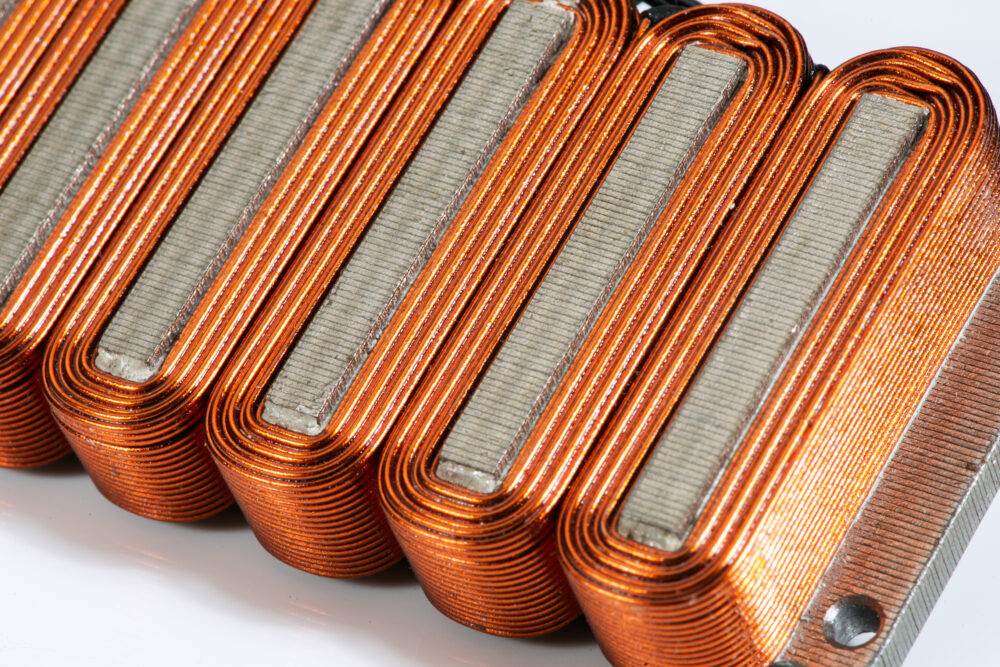
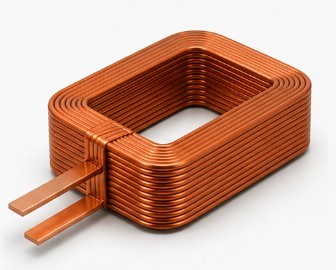
Self-bonding wire features a thermoplastic adhesive overcoat (IEC 60317 Grade 1B or 2B) on top of the electrical insulation. During a controlled baking step, this overcoat reflows and bonds adjacent turns into a monolithic structure — no bobbin, no potting, no external fixation.

Reworkability

A self-bonding coil can be stripped and re-wound on the same tooling. If a winding fault is detected during or after baking, the coil is not scrap — it is a rework. For core-wound coils, particularly those that have been potted, rework is often impossible: the bobbin, potting compound, and coil are destroyed together.

Lifetime and partial discharge

In a core-wound coil, the fixation between turns relies on adhesive applied externally or on compression from potting. Over time — through thermal cycling, vibration, and mechanical ageing — micro-gaps can develop between turns. These gaps are sites for partial discharge (PD), which progressively degrades insulation and eventually leads to failure. In a self-bonding coil, the thermoplastic bond layer fills the orthocyclic voids during baking and pressing, leaving no air-filled gaps where PD can initiate. Additionally, any minor insulation damage sustained during winding is absorbed by the bonding layer, which reflows around the damage site during baking rather than leaving an exposed defect.

Mechanical stability

The baked and pressed winding pack forms a stiff, robust monolithic structure. It handles vibration, shock, and thermal cycling without the loosening that can affect adhesive-fixed or tie-down-secured windings on core. The dimensional stability under load is excellent, because the distributed bond is more uniform than localised fixation points.

Thermal resistance

The bonded turn-to-turn contact provides a continuous thermal path from inner to outer layers. In core-wound coils, air gaps and inconsistent adhesive layers increase inter-turn thermal resistance, creating hot spots that limit the maximum continuous current.

Cost

Electrical baking takes seconds — a current pulse heats the winding, reflows the adhesive, and the coil is bonded. Core-wound coils typically require adhesive application (manual or dispensed), tie-down installation, or potting with cure times measured in minutes to hours. The fixation components themselves (bobbins, adhesive, potting compound, moulding tools) add material cost and tolerance chain links.

Packing fraction

The self-bonding overcoat occupies volume — it is an additional layer on the wire around 5% of the diameter. This gives core-wound coils a theoretical packing advantage, since the same wire without the bonding layer has a marginally smaller outer diameter. In practice, however, this advantage is rarely realised: core-wound coils suffer from looser turn positioning (no orthocyclic void interlocking), clearance gaps between winding and bobbin, and adhesive or potting compound that displaces copper volume. After baking and pressing, the self-bonding coil's bond layer fills the orthocyclic voids and the practical packing fraction typically exceeds that of a core-wound equivalent.

Winding on Core

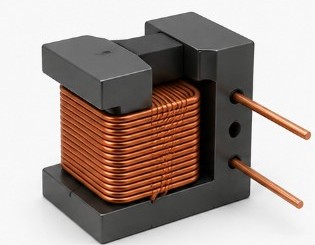
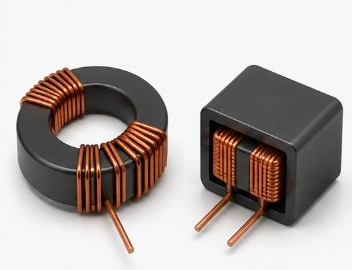
Winding on a bobbin or core remains a well-established and sometimes necessary approach. The bobbin provides a mechanical reference surface, locates the winding in the assembly, and can serve as a structural element (for example, as a flux guide in ferrite-core inductors).

Fixation of the winding on core is achieved through various methods: impregnation with adhesive, tie-down threads or tapes, encapsulation in potting compound, or a combination of these. Each adds process steps, materials, and tolerance chain links. The bobbin itself must be manufactured to tolerance, and clearances between winding and bobbin introduce dimensional uncertainty that propagates into the final assembly. For potted coils, the encapsulation process is covered in Epoxy Casting. Coil assembly and integration — including mounting, lead routing, and thermal interfaces — is treated in Coil Assemblies.

When Winding on Core Is the Right Choice

Self-bonding coils are limited by the glass transition (~100 °C) and reflow temperature (~200 °C) of the bonding material. If the coil must operate continuously or occasionally at these temperatures, the bond loses its mechanical function and the coil structure degrades. In these high-temperature applications, winding on a core with high-temperature adhesives, ceramic bobbins, or inorganic insulation systems is the correct choice. Winding on core may also be preferred when the bobbin provides a structural function that cannot practically be replaced — for example, when it serves as a flux-guiding element, provides precise mechanical registration to the surrounding assembly, or integrates lead termination and connector features.

Hybrid Approaches

Self-bonding and core-based construction are not mutually exclusive. A core-wounded coil can potted to approach the structural and thermal performance of a self-bonding coil. Alternatively, a self-bonding coil can be wound directly on a core that remains in the final assembly, combining the winding quality of self-bonding with the assembly features of a core-based design.

Q&A

Why does self-bonding outperform adhesive fixation for mechanical stability?

Self-bonding creates a distributed bond at every turn-to-turn interface simultaneously during baking. Adhesive fixation is applied externally — by impregnation, dispensing, or potting — and relies on the adhesive penetrating into the winding pack. Penetration is never complete or uniform, leaving sections where turns are held only by friction. Under vibration or thermal cycling, these weakly bonded regions are the first to loosen.

How does partial discharge develop in core-wound coils over time?

Thermal cycling causes differential expansion between the conductor, insulation, and fixation materials. Over thousands of cycles, micro-gaps open at turn-to-turn and turn-to-core interfaces. In these air-filled gaps, the dielectric strength is much lower than in the surrounding insulation. At sufficient voltage, partial discharges ignite in the gaps, progressively eroding the adjacent insulation until a full turn-to-turn short develops.

Can self-bonding coils be used in vacuum applications?

Yes, but the bonding material must be qualified for vacuum compatibility — specifically, its outgassing characteristics (total mass loss and collected volatile condensable materials) must meet the application's cleanliness requirements. Standard thermoplastic bonding materials are acceptable for moderate vacuum levels. For ultra-high vacuum, the bonding material may need to be replaced with a vacuum-qualified adhesive or the coil may need a post-bake vacuum bake-out step.

How does the choice affect lead termination?

Self-bonding coils require the lead-out wire to be managed before baking, since the bonding step fixes the wire positions. Core-wound coils can route leads through features in the bobbin (slots, channels, terminal pins), which simplifies termination but adds bobbin complexity. See Coil Specifications for termination details.

What is the practical cost difference?

The cost advantage of self-bonding comes from three sources: no fixation components (bobbins, adhesives, tie-downs), faster fixation (seconds vs. minutes to hours), and reworkability (a defective winding is a rework, not scrap). For series production, these savings compound. The only added cost is the self-bonding wire itself, which carries a modest premium over standard enamelled wire — typically far less than the cost of the bobbin and fixation process it eliminates.

Discover our custom-designed coil assemblies

We partner with our customers to engineer and manufacture high-quality coils assemblies. Through close collaboration, we tailor each solution to meet exact application requirements—ensuring reliability, performance, and seamless integration into advanced systems.

More information


Contact our expert Stefan Slot

Get expert advice on custom coil assemblies tailored to your application.