Wire Insulation for Precision Coils - Grades, Materials, and Lifetime

Key Technical Insights

  • IEC 60317 defines three principal grades with enamel build thicknesses ranging from ~5 µm on fine wire to ~50 µm on heavy wire, directly trading dielectric strength against fill factor.
  • Insulation material sets the thermal ceiling: polyurethane at 130 °C to polyamide-imide at 220 °C, with glass transition temperature (Tg) as the critical lifetime parameter.
  • Every 8–10 °C above the rated thermal class roughly halves insulation lifetime - thermal design must keep hotspot temperatures below Tg with margin.
  • Wire tension during winding is the primary control for insulation integrity: the enamel is only micrometres thick, and both excessive and insufficient tension cause damage.


Open PDF Version

Introduction

The insulation system determines a coil's dielectric strength, thermal class, and — because it occupies volume — its fill factor. Selecting the right grade and material is a design decision that interacts directly with wire type, winding method, and operating conditions. This paper covers the IEC 60317 grading system, standard and special-purpose insulation materials, quantitative thickness and dielectric data, thermal lifetime, and the process controls that preserve insulation integrity during winding. Self-bonding overcoats are treated in Self-Bonding vs. Winding on Core.

IEC 60317 Insulation Grades

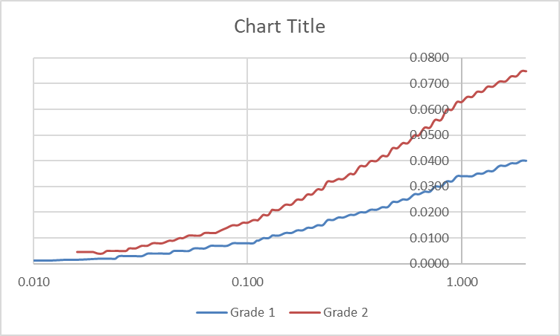
60317 specifies enamelled round wire and defines insulation build as a function of wire diameter. Grade 2 provides roughly double the enamel area of Grade 1, and Grade 3 roughly triple, see figure 2. The specific breakdown voltage depends on the material, see table 1, such that the absolute breakdown voltage follows the insulation thickness. These values apply to new wire tested per IEC 60317 methods. In-service dielectric strength is lower due to ageing, mechanical stress, and thermal degradation. Qualification testing of finished coils (see Qualification Testing) uses test voltages derived from the application's working voltage with appropriate safety factors.

Enamel build thickness varies with nominal wire diameter[Iv12.1]. Dielectric strength sets a theoretical minimum, but IEC 60317 uses size dependent minimum to ensure manufacturability, mechanical integrity, testability and safety margins across real-world materials and processes. The "B" suffix adds a self-bonding overcoat (see Self-Bonding vs. Winding on Core).

Standard Insulation Materials

Material

Thermal class (°C)

Tg (°C)

Dielectric strength (kV/mm)

Key properties

Polyurethane (PU)

130 – 155

120 - 140

80 - 120

Solderable without stripping, flexible

Polyester (PE)

155

140 - 160

100 - 140

Good mechanical strength, cost-effective

Polyesterimide (PEI)

180

170 - 190

120 - 160

High thermal and chemical resistance

Polyamide-imide (PAI)

220

250 - 280

150 - 200

Highest thermal class, excellent abrasion resistance

The glass transition temperature (Tg) is the point at which the polymer transitions from a rigid, glassy state to a soft, rubbery one. Below Tg, the insulation is dimensionally stable and mechanically strong. Above Tg, it softens, becomes susceptible to abrasion and compression, and — for self-bonding coils — the adhesive overcoat loses its structural function. Thermal design must ensure that hotspot temperatures under worst-case conditions (maximum duty cycle, highest ambient, aged thermal resistance) remain below Tg with margin.
The thermal class is usually taken to give 20.000 h of lifetime at the rated thermal class temperature. At lower operating temperatures, lifetime extends dramatically, following Arrhenius: every 10 °C doubles the lifetime. Above this temperature it halves per 10 °C, which relationship is used to estimate service life from accelerated ageing test data.
Multi-layer insulation systems are common in higher-performance wire — for example, a polyesterimide base coat for thermal resistance topped with polyamide-imide for abrasion protection. The self-bonding overcoat, where present, sits on top as the outermost layer.
Solderable insulation (notably polyurethane) allows direct soldering without stripping, simplifying lead termination. The lower thermal class limits its use to applications where hotspot temperatures remain well below 155 °C. Higher-thermal-class insulations require mechanical or laser stripping before soldering.

Special-Purpose Insulation

Standard enamel insulation covers the majority of applications, but certain environments require specialised solutions.

Vacuum-compatible insulation

Coils operating in vacuum must meet strict outgassing requirements — typically specified as total mass loss (TML) and collected volatile condensable materials (CVCM) per ASTM E595 or equivalent. Standard polyurethane and polyester enamels can outgas sufficiently to contaminate sensitive optical or detector surfaces. Polyimide (Kapton-type) film wrapping and polyamide-imide enamels generally meet vacuum requirements. For ultra-high vacuum, a post-cure vacuum bake-out at elevated temperature drives off residual volatiles.

High-cleanliness insulation

Applications in semiconductor lithography, medical devices, and cleanroom environments impose particle and molecular contamination limits. The insulation must not shed particles during winding, baking, or service. Polyamide-imide enamels with high abrasion resistance perform well here. Wire handling, winding, and baking must all take place in controlled-cleanliness environments, and incoming inspection includes surface particle counts.

High-temperature insulation

Above the 220 °C ceiling of polyamide-imide, conventional organic enamels are no longer viable. Options include ceramic-coated wire (alumina or zirconia applied by sol-gel or plasma spray), PTFE (polytetrafluoroethylene) wrapping or extrusion (continuous use to ~260 °C, but thick and reducing fill factor), glass-fibre served wire (up to 400 °C+), and mica-tape insulation for very high temperatures. These materials are thicker and less uniform than enamel, reducing fill factor and winding precision. They are used only when the temperature requirement cannot be met by reducing hotspot temperatures through thermal design improvements.

Insulation Damage and Wire Tension Control

Wire tension during winding is the primary process control for insulation integrity. The enamel is only micrometres thick, and the winding process subjects it to stress on every turn.

Excessive tension stretches the wire and thins the enamel at bending points — crossovers where the wire transitions between layers, and corners on non-circular coil bodies. Micro-cracking can occur without visible signs, only to appear later in dielectric testing or, worse, in service.

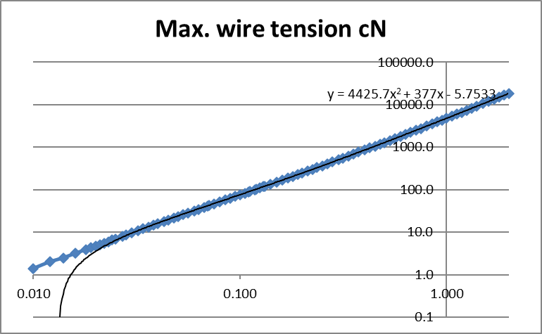
Insufficient tension allows the wire to lift from the coil body, disrupting orthocyclic buildup and creating voids that reduce fill factor, impede thermal conduction, and leave unbonded regions in self-bonding coils. The damage mechanisms differ by wire type. Round wire enamel is most vulnerable at crossovers. Rectangular wire insulation is additionally stressed at the edges, where the coating is thinnest. Foil insulation can be pinched at wrinkles or folds. Modern CNC winding machines regulate tension dynamically, adjusting for coil diameter, layer number, and traverse speed. For precision applications, tension is specified as a function of wire diameter and insulation grade, and monitored continuously. Finished-coil qualification testing (see Qualification Testing) includes dielectric strength measurements that verify insulation integrity from first turn to last.

Q&A

How much fill factor does insulation cost?

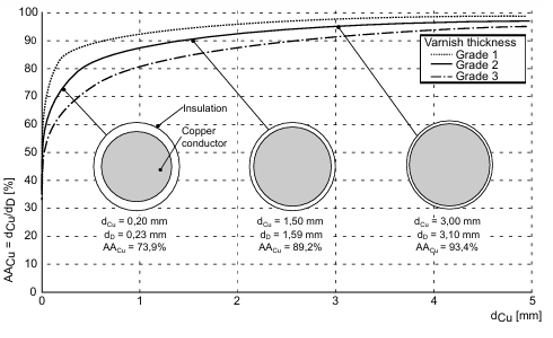
For a 0.01 mm Grade 1 copper core, 27% of the wire area is insulation, while only 7.5% for 2 mm copper core. Grade 2 and Grade 3 lower this further by approximately a factor two and three respectively. These single-wire fractions multiply with the winding geometry fill factor to give the overall copper fill factor of the coil.

Can insulation grade be upgraded as a safety margin without trade-offs?

Moving from Grade 1 to Grade 3 roughly doubles the enamel thickness, improving dielectric strength and mechanical protection by the same factor, but reducing copper fill factor. In tightly constrained winding spaces, this can mean fewer turns or finer wire, requiring re-optimisation of the electrical design. The upgrade should be driven by a specific voltage or reliability requirement, not applied as a blanket safety factor.

What happens if a coil operates continuously above Tg?

The polymer softens, mechanical properties degrade, and the insulation becomes susceptible to compression and abrasion. Over time, dielectric strength decreases, dimensional stability is lost, and turn-to-turn short risk rises. The degradation roughly doubles in rate for every 10 °C above the rated thermal class (Arrhenius’ rule). Even brief excursions above Tg during transient overloads can cause cumulative damage if they occur frequently.

When is special-purpose insulation justified over standard enamel?

When the operating environment exceeds the capabilities of polyamide-imide (>220 °C), when vacuum outgassing would contaminate sensitive surfaces, or when cleanroom particle requirements cannot be met with standard enamel. In all other cases, standard IEC 60317 enamels offer the best combination of performance, cost, and supply availability.

How does insulation material choice affect coil repairability?

Polyurethane-insulated wire can be soldered directly without stripping, making re-termination straightforward. Polyesterimide and polyamide-imide insulations resist soldering temperatures and require mechanical or laser stripping first. For coils that may need rework or field repair, this directly affects service logistics.

Discover our custom-designed coil assemblies

We partner with our customers to engineer and manufacture high-quality coils assemblies. Through close collaboration, we tailor each solution to meet exact application requirements—ensuring reliability, performance, and seamless integration into advanced systems.

More information

Contact our expert Stefan Slot

Get expert advice on custom coil assemblies tailored to your application.