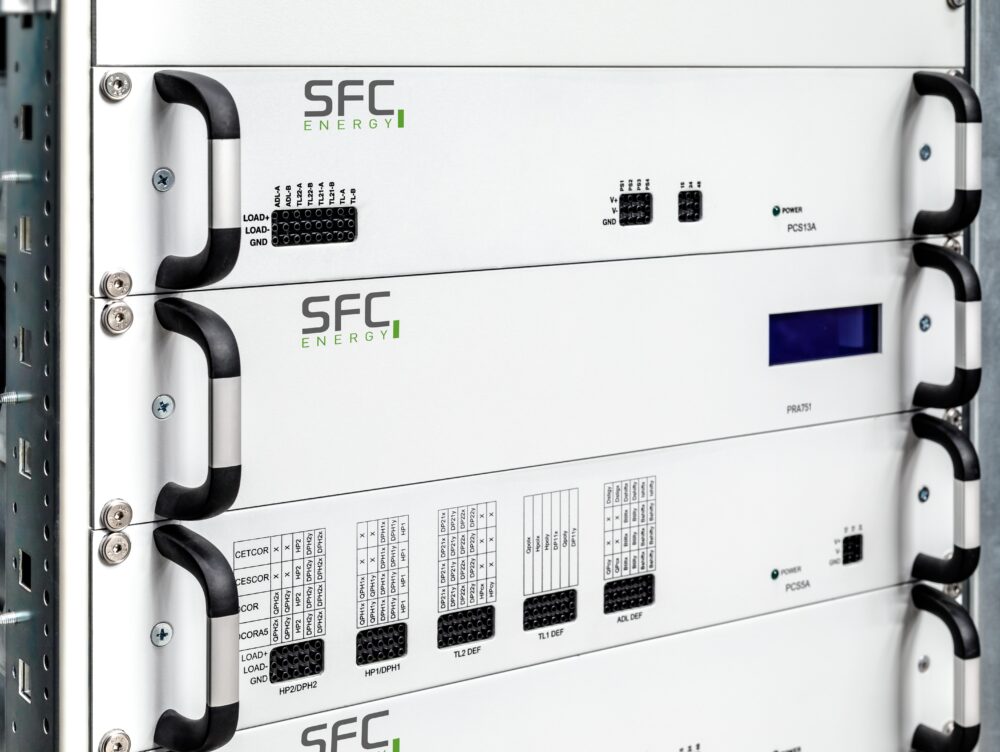
Custom Power Supply Solutions in Demanding Applications

How outcome-driven PSU customization reduces risk, lowers TCO, and ensures first-pass integration.

Key Technical Insights

  • In high-performance applications, PSUs should be customized for maximum value-add.
  • Our customization methodology translates preliminary customer requirements into validated, engineered and manufacturable designs.
  • Preliminary non-technical challenges are Time-to-Market, NRE allocation, managing hidden cost drivers and lifecycle management.


Open PDF Version

Introduction

Catalogue PSUs often fail in tightly integrated, harsh, or unusual electrical systems, causing redesigns, delays, or reduced performance. Our customization turns early system needs into manufacturable solutions that cut integration risk, speed time-to-market, and justify NRE for high value programs.

The challenge: why catalogue PSUs fall short

Complex systems usually impose demanding requirements: transient behavior, EMI margins in constrained environments, thermal path tradeoffs, and lifecycle/qualification requirements. Catalogue power supplies are not designed to meet every situation. The typical consequences are late R&D surprises, extended qualification, field fixes, and hidden lifecycle costs.

Attribute

Typical outcome with catalogue PSU

Outcome with targeted customization

Spec clarity

Customer focus on limited specs and/or overspecification (‘just in case’)

Outcome with targeted customization

Integration risk

Integration rework during subsystem test

First-Time-Right integration, reduced rework

Time-to-Market

Delays from iterative fixes

Shorter qualification path with defined gates

Economics

Lower unit cost but higher lifecycle cost

NRE + optimized unit cost and lower TCO

Our approach: Discovery → Design → Deliver → Support

We convert system level needs into validated designs via four disciplined stages. We focus on the system needs in power and project constraints — working with customers to balance technical goals, budgets and volumes.


Discovery

Capture functions, constraints, standards/norms, compliancy (e.g. RoHS, REACH, SEMI F47)


Concept validation

  • Simulations and reference blocks to evaluate trade-offs (e.g., separate PFC vs integrated, modular DC/DC reuse)
  • deliverable: concept design and trade-off analysis.

Prototype & qualification

  • Iterative builds and subsystem tests (EMC, thermal, burn in);
  • deliverable: qualification report and working prototype

Production & support

  • Transfer to volume with process validation, warranty, spares plan.
  • deliverable: series production start

We’re a power sparring partner — together we built a better product than the customer first imagined.

Jan Heeringa, Sales Manager

Proof points

We work cross functionally to convert system constraints into validated designs that meet technical and commercial objectives. Here we list some real-world cases where our Discovery resulted in significant deviation from the initial request.

Actual customer ask

What we found in Discovery

Final solution (design change)

DMU outcome (benefit/metric)

Stand-alone PFC and DC DC units for legacy reasons.

Reuse of either unit was virtual impossible due to architecture choices. PSUs split had little hard technical rationale.

Integrated but modular PSU, with forward-compatibility sub-modules to enable reuse in future.

Reduced interfaces, volume, and costs. Reuse across projects; reduced future NRE and faster follow on projects

High‑accuracy current readout (~0.5%)

User only cared about crude current usage and monitor was not process critical.

Omitted high-cost sensing with 2 to 5% accuracy solution.

Unit cost reduced sharply while no operational downgrade.

Profinet interface requested

Customer only specified bus name, not protocol details or EMI susceptibility

EtherCAT add-on in same hardware and small firmware changes; clarified protocol and galvanic isolation needs

Protocol clarity, backward and forward compatibility of interface

“Best of specs”

Client specified best-of-class across all parameters (low ripple, low cost, tiny form factor, fast ramp).

Facilitated formal trade-off session, produced prioritized acceptance criteria

Clear acceptance tests; avoided scope creep and late change orders

Late scope changes with tight schedule with

Program deadlines were fixed; late feature requests threatened delivery

Parallel workstreams, MVP milestones matching customer validation plan

Met program milestones; manageable risk—emphasize this in procurement discussions

We don’t deliver what the customer ask for, but what they need.

René Dingshoff, Senior Power Technologist

Planning & business case aspects for custom PSUs

Besides hard technical specs, projects are driven by NRE, amortization, contract risk and standards compliance. We found addressing below challenges early are a necessity for any successful project.

  • Time-to-Market: T2M is often the key business driver, but hard to quantify. A common trade-off is to increase NRE to speed-up development, e.g. parallel R&D, back-up designs of high-risk modules, MVP realization.
  • Hidden cost drivers e.g. operational impact of non-compliancy to PFC, EMI, and standards. These can lead to reduced performance of nearby systems or even penalties.
  • Uncertainty in requirements: due to time pressure, we see often over-specification of hard specs and missing of norms/standards. Fixing this later in the project can dwarf per‑unit savings from catalogue parts. Additionally, compliance timelines and testing costs must be included in the business case.
  • IP & ownership: determine who owns design IP and spare responsibilities; this affects long‑term sourcing and MRO cost.
  • Risk allocation: milestone payments, acceptance tests, warranty caps, spares agreements and a production‑transfer plan reduce DMU exposure.

We emphasise here that these aspects must also make sense from our business perspective. Concretely, this means we only engage in projects that utilize our building blocks
and added value, and that we adhere to concurrent engineering principles.

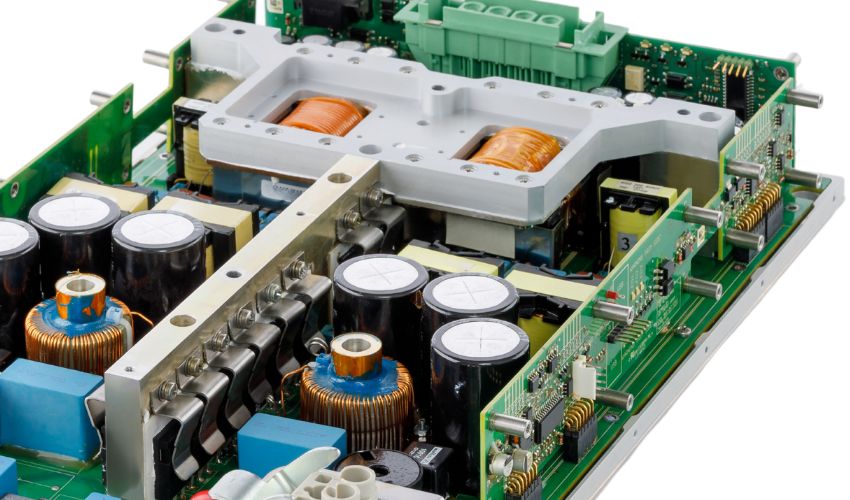
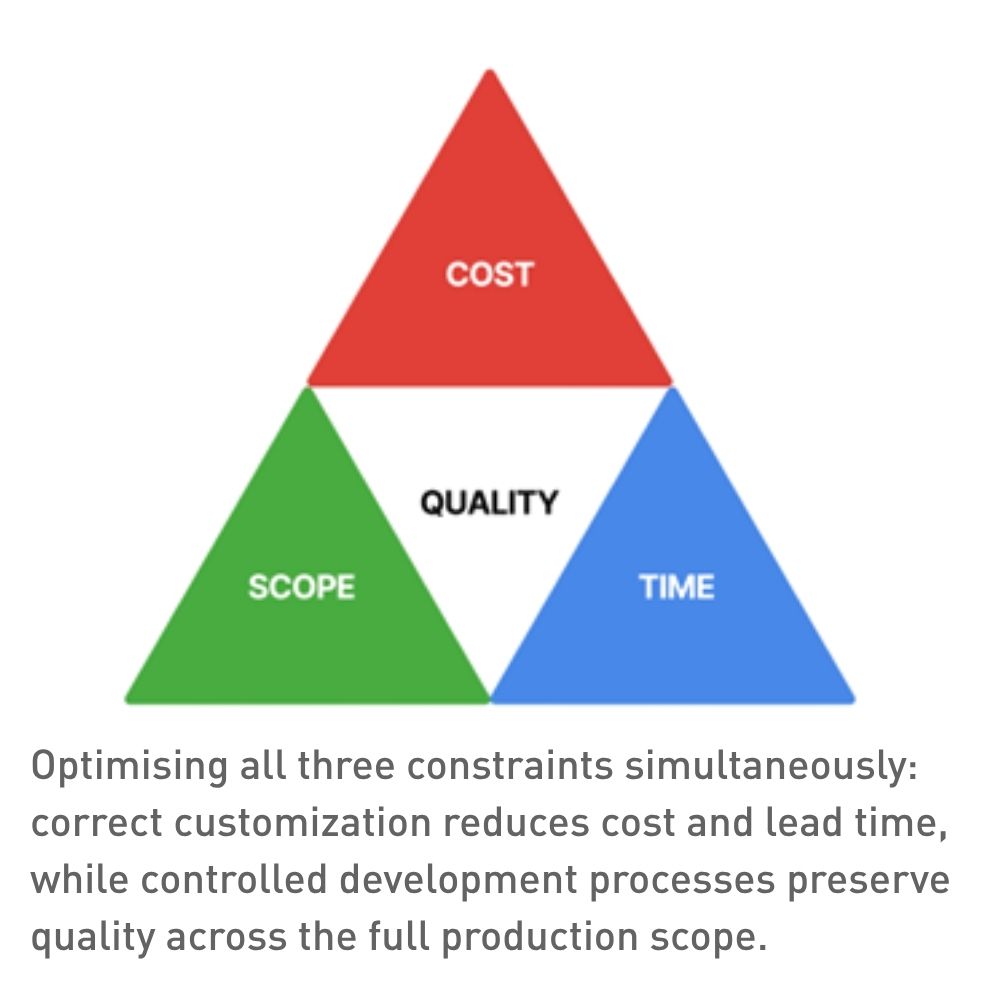
Our processes absorb scope changes while keeping deadlines through parallel teams and reuse of proven building blocks.

Mark Kousman, Head of Development

Q&A

When does power supply unit (PSU) customization produce the most value?

For high‑performance or safety‑critical systems where catalogue parts miss system constraints (EMC, thermal, sequencing). Value is maximized by targeted, gradual changes that fix real system pain points, avoid over‑specification and enable reuse across programs.

How do you turn an initial, vague customer request into a manufacturable power supply unit (PSU)?

Through a four‑stage process: Discovery (constraints, transients, EMC, thermal, standards), Concept validation (simulation + reference blocks), Prototype & qualification (EMC, thermal cycling), and Production & support (process transfer, SLAs, burn-in, lifecycle management).

What are common pitfalls in defining initial specs?

Users may over- or underspecify functional specs and focus only on voltage/current, name a bus without protocol, or omit required standards (EMC, shock, materials). Other examples are to overspecify accuracy, or combine contradictory “best‑of” requirements that conflict technically and commercially.

How should procurement and program managers evaluate the business case for customization?

Run an NRE amortization: Units to pay back = NRE / (unit price delta). Include hard cost drivers (PFC complexity, EMI testing, thermal solutions, certification), assess expected lifetime volumes, IP ownership needs, schedule tolerance, and propose milestone payments and acceptance tests to allocate risk.

How do you control schedule and technical risk during a custom PSU project?

Use upfront risk assessment, clear acceptance criteria, decision gates (spec freeze, prototype, qualification), concurrent workstreams, MVP staging (defer non‑critical system tests to later integration when safe), and reuse of modular cores and test rigs to shorten iterations and absorb scope changes.

What technical tradeoffs should the decision‑making unit understand?

Key tradeoffs include ramp vs ripple (filter cost vs transient behavior), efficiency vs reliability, accuracy vs cost, and the cost/time impact of meeting higher standards and extensive EMI mitigation.

Discover our scalable power platforms

We partner with our customers to engineer and manufacture high-quality power supplies. Through close collaboration, we tailor each solution to meet exact application requirements—ensuring reliability, performance, and seamless integration into advanced systems.

More information

AI-generated


Contact our expert Rene Dingshoff

Get expert advice on custom power supplies tailored to your application.