
A mathematical graph that delineates the relationship between the breakdown voltage (the minimum voltage required to initiate an electric arc or discharge) and the product of the gas pressure and the gap distance between two parallel electrodes. Named after Friedrich Paschen, who empirically discovered the law in 1889, it serves as a foundational principle in plasma physics, high-voltage engineering, and semiconductor manufacturing.
Mathematical Expression: Paschen's Law states that the breakdown voltage (V_B) is a non-linear function of the gas pressure (p) and the electrode gap distance (d), typically expressed as:
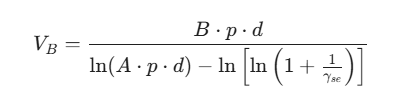
Where A and B are composition-dependent constants determined by the specific gas, and is the secondary electron emission coefficient of the electrode material.
The Paschen Curve Behavior
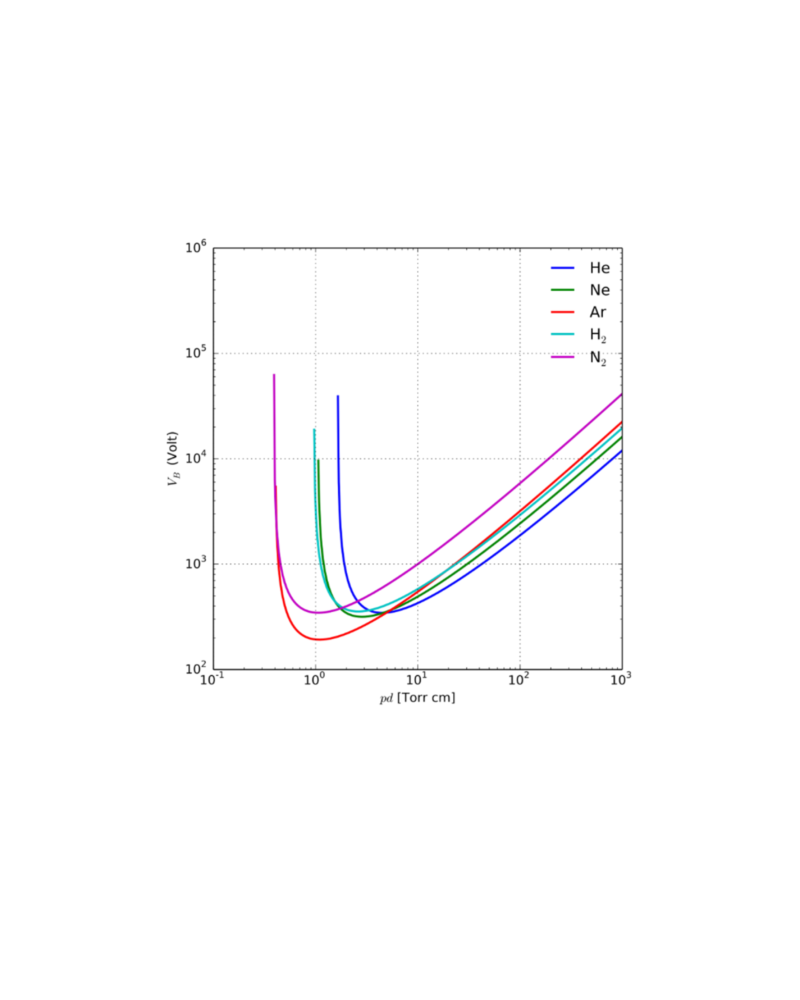
The curve exhibits a highly distinct asymmetric "V" shape, featuring a definitive minimum point VBmin that splits the breakdown behavior into two distinct physical regimes:
Engineering Applications & Material Context
Field of Application | Operational Challenge / Use Case | Paschen Curve Impact |
Aerospace Electronics | Extinguishing electrical arcs in power grid switchgear. | Utilizes gases with high dielectric strength and heavy molecular weights (such as Sulfur Hexafluoride) to push the entire Paschen curve upward, preventing arcing. |
Aerospace Electronics | Preventing electrical arcing in unpressurized aircraft components at high altitudes. | As an aircraft ascends, atmospheric pressure (p) drops. Electronic systems that are perfectly safe at sea level can inadvertently drift into the Paschen minimum at high altitudes, causing catastrophic short circuits. |
MEMS & Semiconductor Gaps | Designing sub-micron spacing on silicon wafers without causing electrical breakdown. | At microscopic distances (d), the p x d product drops below the Paschen minimum. This allows sub-micron electronic components to withstand surprisingly high voltages without sparking, operating safely on the steep left side of the curve. |